
|
| You might also like: | Butterfly Glossary: P | All About Butterflies - What is a Butterfly? | Butterfly Glossary: H | Caterpillar Anatomy | Label the Caterpillar Diagram Printout | Today's featured page: Leaf Tracing/Cutting Template |
| Our subscribers' grade-level estimate for this page: 2nd - 3rd |
| All About Butterflies More on Caterpillars | Animal Printouts Label Me! Printouts |
Diet: Caterpillars mostly eat the leaves of flowering plants and trees, using their powerful jaws (mandibles). Caterpillars are very limited in their diet; many species will only eat the leaves of a single type of plant. They usually eat only the plant that their mother carefully chose to lay their egg on.
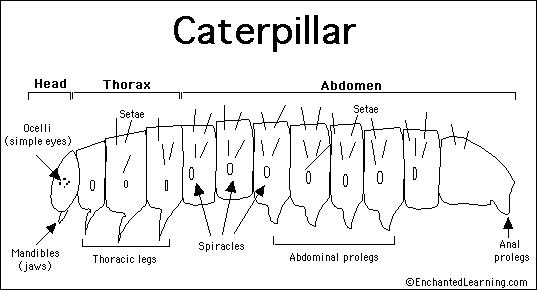
Anatomy: The body of the caterpillar (like all insects) is divided into 3 parts, the head, thorax, and abdomen. They have an exoskeleton, a hard, outer covering.
The ocelli (simple eyes that detect light) are located on the head. The mouth and jaws (mandibles) are also located on the head. Setae are sensory hairs located all over a caterpillar's body, giving it a sense of touch. The caterpillar breathes through holes in its side called spiracles. The six prolegs (attached to the thorax) will become the legs of the adult. The many prolegs will disappear in the adult stage.
Life Cycle of a Butterfly: Egg --> Larva (the caterpillar) --> Pupa (the chrysalis or cocoon) --> Adult.
| Search the Enchanted Learning website for: |