
|
| You might also like: | Nightingale Printout | Oriole Printout | American Crow Printout | Robin Printout | Red-Tailed Hawk Printout | Today's featured page: Emperor Penguin Printout |
| All About Birds | EnchantedLearning.com Nuthatch |
Animal Printouts Label Me! Printouts |
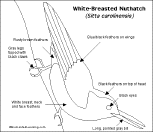
This is a thumbnail of the nuthatch image. The full-size printout is available only to site members.
To subscribe to Enchanted Learning, click here.
If you are already a site member, click here.
If you see a bird hopping down a tree trunk head first, the bird is a nuthatch. This small perching bird is very acrobatic and fast-moving.The Name: In order to crack open a hard nutshell, the Eurasian Nuthatch (Sitta europaea) wedges a nut into a crevice in tree bark; the bird then hits the nut repeatedly with its strong bill, using the bill in a hatchet-like manner. People named the nuthatch for this behavior.
Anatomy: The nuthatch has a relatively large head, a short tail, strong feet, and a powerful bill (beak). Nuthatches have blue-gray feathers on top and a light-colored belly. The white-breasted nuthatch is 5 - 6 inches long (13 - 15 cm).
Diet: Most nuthatches are omnivorous; they eat insects, nuts, and seeds. Nuthatches often store seeds in tree bark for a later meal.
Habitat and Range: Most nuthatches live in forests; a few live in rocky areas. This songbird is found across North America, Europe, and Asia. Most nuthatches do not migrate.
Nest and Eggs: Nuthatches make nests in holes high in the trees (they use old woodpecker holes or decayed areas). Eggs are laid in large clutches (a clutch is a set of eggs laid at one time)
Classification: Kingdom Animalia (animals), Phylum Chordata (chordates), Class Aves (birds), Order Passeriformes (perching birds/songbirds), Family Sittidae (nuthatches), Genus Sitta, many Species.
| Search the Enchanted Learning website for: |