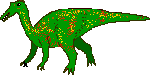


| NAME | Meaning - Baryonyx means “heavy claw” |
|---|---|
| DIET | Carnivore (meat-eater) A fossilized Baryonyx was found with a fossilized meal in its stomach; this stomach contained fish scales, fish bones, and some partially digested bones of a young Iguanodon. So far, Baryonyx is the only known dinosaur that ate fish. It may have waded in rivers and shallow seas to catch fish (just as some modern-day bears do). |
| SIZE | Length - 32 feet (9.5 m) long |
| WHEN IT LIVED | Early to middle Cretaceous period, about 125 million years ago |
| WHERE IT LIVED | Fossils have been found in England, Europe. |
| FOSSILS | Baryonyx was found in 1983 in a clay pit in Surrey, England, by the British amateur fossil hunter William Walker. It was the first carnivorous (meat-eating) dinosaur found in England. About 70% of this dinosaur’s skeleton was found. Baryonyx was found 30 miles south of London, England, in 1983. |
| CLASSIFICATION |
|
| INTERESTING FACTS | Baryonyx had huge 1-foot (30.5-cm) long claws on its hands (hence its name). It had long, narrow, crocodile-like jaws with 96 small, serrated teeth (this is 1.5 times the number of teeth that most other theropods had). It had a small crest on its snout. Baryonyx had a long, straight neck (unlike other theropods, who had s-shaped necks) and a long tail. Its low-slung body was supported by 2 large rear legs and 2 slightly smaller arms. |
| LINKS |