


A page of punctuation marks and other common symbols from the Little Explorers Picture Dictionary in English.
Punctuation Marks
Punctuation marks are symbols that are used in sentences and phrases to make the meaning clearer.

The acute accent is a symbol placed over a vowel in some languages (for example, French and Spanish).

An ampersand (&) is a symbol that means “and.”

An apostrophe is a symbol that indicates that some letters have been omitted from a word (for example, “do not” can be written as the contraction “don’t”). Apostrophes are also used to show possession (for example, Jane’s doll means a doll belonging to Jane).

The @ on keyboards and in email addresses is called the “at sign.” You can write one easily by writing a lower case a, then continuing to draw an almost-complete circle around the a.

A check is mark that is used to note that something has been done or is correct.

Circumflex is an accent placed over a vowel in some languages (such as French).

A colon (:) is a punctuation mark that is used to introduce a list in a sentence or a quote, to separate two major parts of a sentence, to indicate a ratio (such as 1:2) or a time (8:15). For example: These students were on the honor roll: Lisa, Jason, and Jessica.
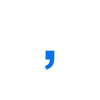
A comma is a punctuation mark used to separate words indepnedent phrases or clauses in a sentence.

A dash is a punctuation mark used to separate parts of a sentence. For example: The dash is also known as an “em dash” because it is the length of a printed letter m – it is longer than a hyphen.

A dot is a tiny speck or a period.

An ellipsis is three dots in a row; it is used to indicate that part of a sentence or sequence has been omitted. It is spoken, “dot, dot, dot.” One example of the use of an ellipsis is: Smith said, “Rome had many terrible leaders, … who caused the Empire to fall.” Another example is the mathematical series: 1,3,5,7,9,… (the rest of the odd numbers are implied but not written down).

An exclamation point is a punctuation mark that is used to show strong feeling!

The grave accent is a symbol placed over a vowel in some languages (such as French).

The hyphen (-) is a punctuation mark used to join or to separate words. Some examples of hyphenated words are: merry-go-round, light-blue, twenty-four, and re-entry.

A paragraph is a one or more sentences that cover a single topic. The symbol for paragraph is ¶.

A question mark lets you know that a sentence is a question.
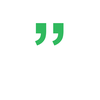
Quotation marks are used around a quote, when you want to relay exactly what was said or written.
“One If By Land, …”
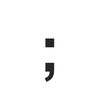
A semicolon (;) is a punctuation mark; it is used to separate major parts of a compound sentence.

Tilde (~) is a mark placed over a letter in some languages (especially Spanish).

Umlaut is an mark placed over a vowel in some languages (especially German).
When you underline (or underscore) something, you draw a line under it. ABC 123