Advertisement.

EnchantedLearning.com is a user-supported site.
As a bonus, site members have access to a banner-ad-free version of the site, with print-friendly pages.
Click here to learn more.

Become a member of Enchanted Learning.
Site subscriptions last 12 months.
Click here for more information on site membership.

$20.00/year or other amount
(directly by Credit Card)

$20.00/year or other amount
(via PayPal)

$20.00/year or other amount
(for sending a check by mail)

$20.00/year or other amount
(for subscribing by school purchase order)
As a thank-you bonus, site members have access to a banner-ad-free version of the site, with print-friendly pages.
(Already a member? Click here.)

Go to the Answers
EnchantedLearning.com
Label the Venn Diagram
Primes, Even Numbers and Multiples of 3
More Math Activities

A prime number is a positive number that has exactly two factors, 1 and itself. Alternatively, you can think of a prime number as a number that is not the product of two smaller numbers. For example, 13 is a prime number because it can only be divided evenly by 1 and 13. For another example, 14 is not a prime number because it can be divided evenly by 1, 2, 7, and 14. The number one is not a prime number becuase it has only one factor, 1 itself.

Where does each of the following numbers belong on the Venn diagram?
2, 3, 4, 5, 6, 7, 8, 9, 10, 11.
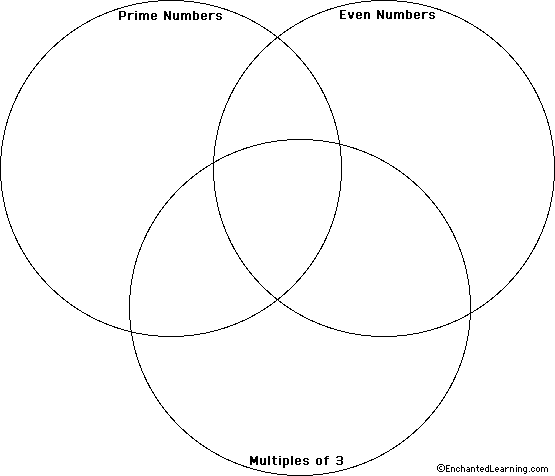

Venn diagram


Enchanted Learning Search

First search engine with spelling correction and pictures!
Search EnchantedLearning.com for all the words:
Enter one or more words, or a short phrase.
You can use an asterisk * as a wild-card.


Advertisement.


Advertisement.


Copyright ©2003-2008 EnchantedLearning.com ------ How to cite a web page