

Advertisement.

EnchantedLearning.com is a user-supported site.
As a bonus, site members have access to a banner-ad-free version of the site, with print-friendly pages.
Click here to learn more.

Join Enchanted Learning
Site subscriptions last 12 months.
Click here for more information on site membership.

As low as $20.00/year (directly by Credit Card)

Site members have access to the entire website with print-friendly pages and no ads.
(Already a member? Click here.)

Zoom Astronomy
The Stars
Lifecycle Nuclear Fusion Brightest Stars Galaxies Other Solar Systems Constellations Why Stars Twinkle
Birth Death Star Types Closest Stars Nebulae Major Stars The Zodiac Activities, Links

The Birth of Stars The Death of Stars
Sun-like Stars
(Up to 1.5 times the mass of the Sun)
Huge Stars
(From 1.5 to 3 times the mass of the Sun)
Giant Stars
(Over 3 times the mass of the Sun)

THE DEATH OF STARS

Stars expand as they grow old. As their core runs out of hydrogen and then helium, the core contacts and the outer layers expand, cool, and become less bright. This is a red giant or a red super giant (depending on the initial mass of the star). It will eventually collapse and explode. A star's life span and eventual fate are determined by the original mass of the star.

Life span:
The most massive stars have the shortest lives. Stars that are 25 to 50 times that of the Sun live for only a few million years. They die so quickly because they burn massive amounts of nuclear fuel.
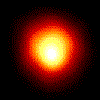
For example, Betelgeuse (the second-brightest star in Orion) is a red supergiant star that is about 20 times more massive than the Sun. It is about 14,000 times brighter than the Sun and burns nuclear fuel at a rate 14,000 times faster than than that of the Sun. The Sun will live about 7,000 times longer than a massive star like Betelgeuse.

Stars like our Sun live for about 10 billion years. Stars less massive than the Sun have even longer life spans.

Fate of a Star:
A star will become either a black dwarf, neutron star, or black hole, depending on how massive it was. .

Sun-like Stars (Mass under 1.5 times the mass of the Sun) --> Red Giant --> Planetary Nebula -->White Dwarf --> Black Dwarf

Huge Stars (Mass between 1.5 to 3 times the mass of the Sun) --> Red SuperGiant --> Supernova --> Neutron Star

Giant Stars (Mass over 3 times the mass of the Sun) --> Red SuperGiant --> Supernova --> Black Hole


EVOLVED STAR

An evolved star is an old star that is near the end of its existence. Its nuclear fuel is mostly gone. The star loses mass from its surface, producing a stellar wind (gas that is ejected from the surface of a star). Older stars produce more stellar wind than younger stars.


STAR LIFE CYCLE WEB LINKS

Virtual Trips to Black Holes and Neutron Stars from NASA


Enchanted Learning®
Over 20,000 Web Pages.
Sample Pages for Prospective Subscribers

Overview of Site
What's New
Enchanted Learning Home
Monthly Activity Calendar
Books to Print
Site Index

K-3
Crafts
K-3 Themes
Little Explorers
Picture dictionary
PreK/K Activities
Rebus Rhymes
Stories
Writing
Cloze Activities
Essay Topics
Newspaper
Writing Activities
Parts of Speech

Fiction
The Test of Time
Biology
Animal Printouts
Biology Label Printouts
Biomes
Birds
Butterflies
Dinosaurs
Food Chain
Human Anatomy
Mammals
Plants
Rainforests
Sharks
Whales
Physical Sciences
Astronomy
The Earth
Geology
Hurricane
Landforms
Oceans
Tsunami
Volcano
Languages
Dutch
French
German
Italian
Japanese (Romaji)
Portuguese
Spanish
Swedish
Geography/History
Explorers
Flags
Geography
Inventors
US History

Other Topics
Art and Artists
Calendars
Crafts
Graphic Organizers
Label Me! Printouts
Math
Music

Click to read our Privacy Policy

E-mail


Enchanted Learning Search

Search the Enchanted Learning website for:


Advertisement.


Advertisement.


Copyright ©1999-2009 EnchantedLearning.com ------ How to cite a web page