Zoobooks magazine for kids!
Advertisement.

EnchantedLearning.com is a user-supported site.
As a bonus, site members have access to a banner-ad-free version of the site, with print-friendly pages.
Click here to learn more.

Become a member of Enchanted Learning.
Site subscriptions last 12 months.
Click here for more information on site membership.

$20.00/year or other amount
(directly by Credit Card)

$20.00/year or other amount
(via PayPal)

$20.00/year or other amount
(for sending a check by mail)

$20.00/year or other amount
(for subscribing by school purchase order)
As a thank-you bonus, site members have access to a banner-ad-free version of the site, with print-friendly pages.
(Already a member? Click here.)

More Information on Birds EnchantedLearning.com
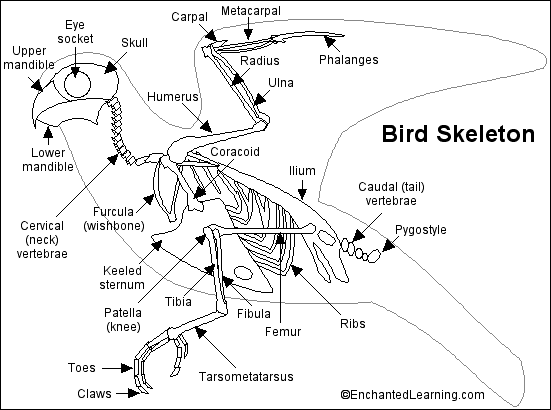
Bird Skeleton
Animal Printouts
Label Me! Printouts

Birds have a lightweight skeleton. Most of the bones of flying birds are thin and hollow; some have internal struts or trusses (cross walls) that make them very strong. (Some flightless birds, like penguins, have solid bones.) The keel-shaped sternum (breastbone) is where the powerful flight muscles attach to the body.

Birds have a smaller total number of bones than mammals or reptiles. This is because many of their bones have fused together (like the middle to lower vertebrae), making the skeleton more rigid. Birds also have more neck (cervical) vertebrae than many other animals; most have 13 to 25 of these very flexible neck vertebrae (this helps them groom their feathers). Birds are are the only vertebrate animals to have a fused collarbone (the furcula or wishbone) or a keeled breastbone.


Enchanted Learning Search

First search engine with spelling correction and pictures!
Search EnchantedLearning.com for all the words:
Enter one or more words, or a short phrase.
You can use an asterisk * as a wild-card.


Advertisement.


Advertisement.


Copyright ©2000-2008 EnchantedLearning.com ------ How to cite a web page