

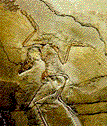


Learn about Archaeopteryx, the earliest-known bird; it lived during the Jurassic period.
| NAME | Meaning - Archaeopteryx means “ancient wing” |
|---|---|
| DIET | Carnivore (meat-eater) |
| SIZE | Length - 1 foot ( 30 cm) long from beak to tail |
| WHEN IT LIVED | Late Jurassic period, about 150 million years ago |
| WHERE IT LIVED | Fossils have been found in Solnhofen, Germany, Europe. |
| FOSSILS | Amazingly detailed Archaeopteryx fossils have been found in fine-grained Jurassic limestone in southern Germany. This fine-grained limestone is used in the lithographic process, hence the species name “lithographica” given to the early Archaeopteryx specimen. The first Archaeopteryx fossil (a feather) was found in 1860 near Solnhofen, Germany, and was named by the German paleontologist Hermann von Meyer in 1861. A total of seven Archaeopteryx specimens have been found, plus the feather. |
| CLASSIFICATION |
|
| INTERESTING FACTS | Archaeopteryx is the oldest-known bird. Unlike modern-day birds, it had teeth, three claws on each wing, a flat sternum (breastbone), belly ribs (gastralia), and a long, bony tail. Like modern-day birds, it had feathers, a lightly-built body with hollow bones, a wishbone (furcula) and reduced fingers. This crow-sized animal may have been able to fly, but not very far and not very well. Although it had feathers and could fly, it had similarities to dinosaurs, including its teeth, skull, lack of a horny bill, and certain bone structures. In 1868, Thomas Henry Huxley interpreted the Archaeopteryx fossil to be a transitional bird having many reptilian features. Using the fossils of Archaeopteryx and Compsognathus, a bird-sized and bird-like dinosaur, Huxley argued that birds and reptiles were descended from common ancestors. Decades later, Huxley’s ideas fell out of favor, only to be reconsidered over a century later (after much research and ado) in the 1970’s. In 1986, J. A. Gauthier looked at over 100 characteristics of birds and dinosaurs and showed that birds belonged to the clade of coelurosaurian dinosaurs. [Gauthier, J.A., 1986. Saurischian monophyly and the origin of birds, in: The Origin of Birds and the Evolution of Flight, California Academy of Sciences Memoir No. 8] |
| LINKS | A detailed page on Archaeopteryx. |