Zoobooks magazine for kids!
Advertisement.

EnchantedLearning.com is a user-supported site.
As a bonus, site members have access to a banner-ad-free version of the site, with print-friendly pages.
Click here to learn more.

Become a member of Enchanted Learning.
Site subscriptions last 12 months.
Click here for more information on site membership.
$20.00/year or other amount
(directly by Credit Card)
$20.00/year or other amount
(via PayPal)
$20.00/year or other amount
(for sending a check by mail)
$20.00/year or other amount
(for subscribing by school purchase order)
As a thank-you bonus, site members have access to a banner-ad-free version of the site, with print-friendly pages.
(Already a member? Click here.)

More Information on Alligators EnchantedLearning.com
Spectacled Caiman
Animal Printouts
Label Me! Printouts


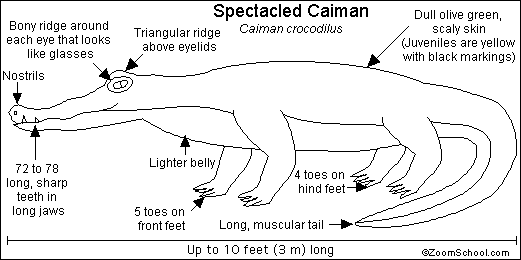
Spectacled Caimans (Caiman crocodilus, formerly C. sclerops) are common, meat-eating reptiles that spend most of their lives in the water. They live in freshwater habitats in South and Central America, including the Amazon basin. They prefer still water, but also live in lowland wetlands, rivers, rain forests, and seasonally flooded savannas. Caimans swim very well, mainly using their tails to propel themselves through the water, and also using their webbed feet. Spectacled Caimans are nocturnal (most active at night).

Anatomy: The largest Spectacled Caiman grows to be up to about 10 feet (6 m) long. It has a bony ridge around the eyes (that looks like a pair of eyeglasses) and a bony ridge above the eyes. The skin is armored. Juveniles are yellow with black markings; adults are dull olive green.

Diet and Teeth: Caimans hunt at night. The young eat insects, crustaceans, mollusks, and fish. Adults eat fish (including piranhas and catfish), birds, turtles, reptiles, and mammals (like wild pigs). Spectacled Caiman are sometimes cannibalistic. They have about 75 long, sharp, conical teeth, which are used for catching prey (but they do not tear it apart - they swallow their prey whole).

Reproduction: Females build a large soil-and-vegetation mound nest and lay 14 to 40 eggs in each clutch.


Enchanted Learning Search

First search engine with spelling correction and pictures!
Search EnchantedLearning.com for all the words:
Enter one or more words, or a short phrase.
You can use an asterisk * as a wild-card.


Advertisement.


Advertisement.


Copyright ©2000-2008 EnchantedLearning.com ------ How to cite a web page