

Zoobooks magazine for kids!
Advertisement.

EnchantedLearning.com is a user-supported site.
As a bonus, site members have access to a banner-ad-free version of the site, with print-friendly pages.
Click here to learn more.

Join Enchanted Learning
Site subscriptions last 12 months.
Click here for more information on site membership.

$20.00/year or other amount
(directly by Credit Card)

$20.00/year or other amount
(via PayPal)

$20.00/year or other amount
(for sending a check by mail)

$20.00/year or other amount
(for subscribing by school purchase order)
As a thank-you bonus, site members have access to a banner-ad-free version of the site, with print-friendly pages.
(Already a member? Click here.)

Enchanted Learning
Zoom Explorers
A B C D E F G H I J K L M N O P Q R S T U V W X Y Z
Africa Antarctica Arctic Australia Canada Mexico North America South America Space Undersea
1300's and Earlier 1400's Early 1500's Late 1500's 1600's 1700's 1800's 1900's Glossary of Exploration Terms

Henry Hudson: Explorer

Henry Hudson (1565-1611) was an English explorer and navigator who explored parts of the Arctic Ocean and northeastern North America. The Hudson River, Hudson Strait, and Hudson Bay are named for Hudson.

Little is known about Hudson's early life. Hudson was hired by the Muscovy Company in 1607, to find a waterway from Europe to Asia. Hudson made two trips (in 1607 and 1608), but failed to find a route to China. In 1607, he sailed to Spitzbergen (an island north of Scandinavia in the Arctic Ocean) and discovered Jan Mayen Island (a tiny island off eastern Greenland). In 1608, he sailed to Novaya Zemlya (an island north of Russia in the Arctic Ocean).

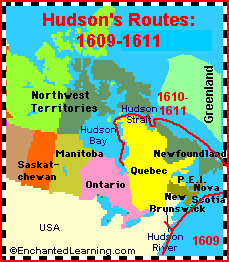
Hudson was then hired by the Dutch East India Company in 1609, to try to find the Northwest Passage farther south. On this trip in a ship called the Half Moon, Hudson sailed to Nova Scotia, and then sailed south. He found what is now called the Hudson River. Hudson is credited with discovering the location which is now New York City (although da Verrazzano had previously sailed by the area in 1524). Hudson sailed into New York's harbor on September 3, 1609 and noted what an excellent harbor it was. Hudson sailed up the river about 150 miles (240 km) and noted the abundance of rich land, but realized that this was not a waterway to India. His reports resulted in many Dutch settlements in the area.

A 1610-1611 trip through the Hudson Strait and into Hudson Bay ended in a mutiny. Hudson died in 1611 after his crew mutinied and left Hudson, his son, and seven crew members adrift in a small, open boat in Hudson Bay.

EnchantedLearning.com
Zoom Explorers
Search EnchantedLearning.com for your explorer:
A B C D E F G H I J K L M N O P Q R S T U V W X Y Z
Africa Antarctica Arctic Australia Canada Mexico North America South America Space Undersea Women
1300's and Earlier 1400's Early 1500's Late 1500's 1600's 1700's 1800's 1900's Glossary of Exploration Terms
Guidelines for Writing a Report on an Explorer


Enchanted Learning®
Over 20,000 Web Pages.
Sample Pages for Prospective Subscribers

Overview of Site
What's New
Enchanted Learning Home
Monthly Activity Calendar
Books to Print
Site Index

K-3
Crafts
K-3 Themes
Little Explorers
Picture dictionary
PreK/K Activities
Rebus Rhymes
Stories
Writing
Cloze Activities
Essay Topics
Newspaper
Writing Activities
Parts of Speech

Fiction
The Test of Time
Biology
Animal Printouts
Biology Label Printouts
Biomes
Birds
Butterflies
Dinosaurs
Food Chain
Human Anatomy
Mammals
Plants
Rainforests
Sharks
Whales
Physical Sciences
Astronomy
The Earth
Geology
Hurricane
Landforms
Oceans
Tsunami
Volcano
Languages
Dutch
French
German
Italian
Japanese (Romaji)
Portuguese
Spanish
Swedish
Geography/History
Explorers
Flags
Geography
Inventors
US History

Other Topics
Art and Artists
Calendars
Crafts
Graphic Organizers
Label Me! Printouts
Math
Music

Click to read our Privacy Policy

E-mail


Enchanted Learning Search

First search engine with spelling correction and pictures!
Search EnchantedLearning.com for all the words:
Enter one or more words, or a short phrase.
You can use an asterisk * as a wild-card.


Advertisement.


Advertisement.


Copyright ©2000-2008 EnchantedLearning.com ------ How to cite a web page