



Inventors and Inventions: the 1700s.

A battery is a device that converts chemical energy into electrical energy. Each battery has two electrodes, an anode (the positive end) and a cathode (the negative end). An electrical circuit runs between these two electrodes, going through a chemical called an electrolyte (which can be either liquid or solid). This unit consisting of two electrodes is called a cell (often called a voltaic cell or pile). Batteries are used to power many devices and make the spark that starts a gasoline engine.
Alessandro Volta was an Italian physicist invented the first chemical battery in 1800.
Storage batteries are lead-based batteries that can be recharged. In 1859, the French physicist Gaston Plante (1834-1889) invented a battery made from two lead plates joined by a wire and immersed in a sulfuric acid electrolyte; this was the first storage battery.
The dry cell is a an improved voltaic cell with a cylindrical zinc shell (the zinc acts as both the cathode and the container) that is lined with an ammonium chloride (the electrolyte) saturated material (and not a liquid). The dry cell battery was developed in the 1870s-1870s by Georges Leclanche of France, who used an electrolyte in the form of a paste.
Edison batteries (also called alkaline batteries) are an improved type of storage battery developed by Thomas Edison. These batteries have an alkaline electrolyte, and not an acid.
For more information on the battery, click here.

The earliest bicycle was a wooden scooter-like contraption called a celerifere; it was invented about 1790 by Comte Mede de Sivrac of France. In 1816, Baron Karl von Drais de Sauerbrun, of Germany, invented a model with a steering bar attached to the front wheel, which he called a Draisienne. It has two wheels (of the same size), and the rider sat between the two wheels, but there were no pedals; to move, you had to propel the bicycle forward using your feet (a bit like a scooter). He exhibited his bicycle in Paris on April 6, 1818.

 Benjamin Franklin invented bifocal glasses in the 1700s. He was nearsighted and had also become farsighted in his middle age. Tired of switching between two pairs of glasses, Franklin cut the lenses of each pair of glasses horizontally, making a single pair of glasses that focused at both near regions (the bottom half of the lenses) and far regions (the top half of the lenses). This new type of glasses let people read and see far away; they are still in use today.

People have been drinking naturally-carbonated water (water with carbon dioxide bubbles) since pre-historic times. The English chemist Joseph Priestley experimented with putting gases in liquids in 1767, producing the first artificially-produced carbonated water.
In 1770, the Swedish chemist Torbern Bergman invented a device for making carbonated water from chalk and sulfuric acid.

Anders Celsius (1701-1744) was a Swedish professor of astronomy who devised the Celsius thermometer. He also ventured to the far north of Sweden with an expedition in order to measure the length of a degree along a meridian, close to the pole, later comparing it with similar measurements made in the Southern Hemisphere. This confirmed that that the shape of the earth is an ellipsoid which is flattened at the poles. He also cataloged 300 stars. With his assistant Olof Hiorter, Celsius discovered the magnetic basis for auroras.
The cotton gin is a machine that cleans cotton, removing its many seeds. This device revolutionized the cotton industry. Previously, this tedious job had been done by hand, using two combs. Eli Whitney (1765-1825) was an American inventor and engineer who invented the cotton gin; he patented the cotton gin on March 14, 1794. The cotton gin made much of the southern United States very rich, but cotton plantation owners rarely paid Whitney for the use of his invention, and Whitney went out of business.

 Benjamin Franklin (January 17, 1706-April 17, 1790) was an American statesman, writer, printer, and inventor. Franklin experimented extensively with electricity. In 1752, his experiments with a kite in a thunderstorm (never do this, many people have died trying it!) led to the development of the lightning rod. Franklin started the first circulating library in the colonies in 1731. He also invented bifocal glasses and the Franklin stove. The idea of daylight savings time was first proposed by Benjamin Franklin in 1784.

Many, many people were being executed during the French Revolution, and Dr. Joseph-Ignace Guillotin (1738-1821) suggested that decapitation would be a more humane method for execution. Experiments with cadavers (dead people) were done. The device that we call the guillotine was invented; it is a tall wooden framework with a hole to keep a person’s head still and a large falling blade. Although he did not invent the machine we call the guillotine, Guillotin’s name is forever attached to it. The guillotine was first was used on April 25, 1792 at the Place de Grève (the victim was a highway man). The most famous victims of the guillotine include the deposed French King Louis XVI and his extravagant wife Queen Marie Antoinette, who were beheaded on January 21, 1793. The guillotine was used in France until 1981, when capital punishment was abolished.
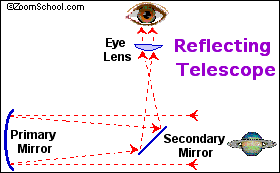 John Hadley (1682-1744) was an English mathematician and inventor who built the first reflecting telescope and invented an improved quadrant in 1731 (known as Hadley’s quadrant). Hadley Rille, a long valley on the surface of the moon, was named for Hadley.
James Hargreaves (1720? - April 22, 1778) was an English weaver and spinner (he spun wool thread using a spinning wheel). He invented the spinning jenny, a hand-powered multiple spinning machine.
The spinning jenny was much more efficient than the spinning wheel. With a spinning wheel, a person could produce only one yarn thread at a time. With Hargreaves’ spinning jenny, a person could produce up to eight threads at once (it used one spinning wheel and 8 spindles on which threads were wound). The thread that the spinning jenny produced was coarse, and was only suited for filling material, but it was still quite a useful invention, and led the way to even better spinning devices.
Hargreaves is said to have gotten the idea for his remarkable invention after his young daughter (named Jenny) overturned his spinning wheel. When it was upturned, it continued to spin, and Hargreaves realized that many spinning wheels could be positioned like this, creating a multiple-wheeled spinning machine.
Hargreaves began selling spinning jenny’s from his home, near Blackburn, Lancashire, England. After hearing of his invention, local spinners became fearful of losing their jobs and broke into Hargreaves’ house, destroying his spinning jennies. He then moved to Nottingham, England (in 1768).
Thomas James became Hargreaves’ partner and they began a spinning mill which used spinning jennies (which could now produce even more threads per machine). Hargreaves patented the spinning jenny on July 12, 1770.

A hot-air balloon is a balloon that is filled with hot air; it rises because hot air is less dense (lighter) than the rest of the air. Joseph and Jacques Etienne Montgolfier were two French bothers who made the first successful hot-air balloon. Their first balloon was launched in December, 1782, and ascended to an altitude of 985 ft (300 m). This type of hot-air balloon was called the Montgolfiére; it was made of paper and used air heated by burning wool and moist straw. The first passengers in a hot-air balloon were a rooster, a sheep, and a duck, whom the Montgolfier brothers sent up to an altitude of 1,640 ft (500 m) on September 19, 1783 (the trip lasted for 8 minutes); the animals survived the landing. This event was observed by King Louis XVI and Queen Marie Antoinette of France.
Clock makers used the idea of interchangeable parts since the early 1700’s. In 1790, the French gunsmith Honoré Blanc demonstrated his muskets entirely made from interchangeable parts; the French government didn’t like the process (since with this process, anyone could manufacture items, and the government lost control), so it was stopped. The idea of interchangeable parts was introduced to American gun manufacturing by Eli Whitney (1765-1825) in 1798. The concept of interchangeable manufacturing parts helped modernize the musket industry (and mass production in general). Whitney made templates for each separate part of the musket (an early gun). The workers then used the template when chiseling the part. Whitney was an American inventor and engineer who also invented the cotton gin.
Mayonnaise was invented in France hundreds of years ago, probably in 1756 by the French chef working for the Duke de Richelieu, The first ready-made mayonnaise was sold in the US in 1905 at Richard Hellman’s deli in New York. Hellman sold his wife’s mayonnaise in open wooden boats. In 1912, he sold the mayonnaise in large glass bottles; the type he called “Hellman’s Blue Ribbon Mayonnaise” was very popular and is still sold today (it is now owned by Best Foods).

The metric system was invented in France. In 1790, the French National Assembly directed the Academy of Sciences of Paris to standardize the units of measurement. A committeee from the Academy used a decimal system and defined the meter to be one 10-millionths of the distance from the equator to the Earth’s Pole (that is, the Earth’s circumference would be equal to 40 million meters). The committee consisted of the mathematicians Jean Charles de Borda (1733-1799), Joseph-Louis Comte de Lagrange (1736-1813), Pierre-Simon Laplace (1749-1827), Gaspard Monge (1746 -1818), and Marie Jean Antoine Nicholas Caritat, the Marquis de Condorcet (1743-1794)
The word meter comes from the Greek word metron, which means measure. The centimeter was defined as one-hundredth of a meter; the kilometer was defined as 1000 meters. The metric system was passed by law in France on August 1, 1793. In 1960, the definition of the meter changed to 1,650,763.73 wavelengths of of the orange-red radiation of krypton 86. In 1983, the meter was redefined as 1/299,792,458 of the distance that light travels in one second in a vacuum.
For the metric unit of mass, the gram was defined as the mass of one cubic centimeter of pure water at a given temperature. In common usage and in commerce, grams are used as a unit of weight.
Joseph (1740-1810) and Jacques Etienne (1745-1799) Montgolfier were two French bothers from Vidalon-les-Annonay, near Lyons, who made the first successful hot-air balloon. Their first balloon was launched in December, 1782, and ascended to an altitude of 985 ft (300 m). This type of hot-air balloon was called the Montgolfiére; it was made of paper and used air heated by burning wool and moist straw. The first passengers in a hot-air balloon were a rooster, a sheep, and a duck, whom the Montgolfier brothers sent up to an altitude of 1,640 ft (500 m) on September 19, 1783 (the trip lasted for 8 minutes); the animals survived the landing. This event was observed by King Louis XVI and Queen Marie Antoinette of France.

A parachute is a device for slowing down one’s descent while falling to the ground. Parachutes are used to skydive from airplanes, to jump from very high places, and to help slow down the descent of spacecraft. Parachutes are also used to slow down some race cars. The early parachutes were made from canvas (a strong cotton cloth). Light-weight (but very strong) silk cloth was then introduced for parachutes. Modern-day parachutes use nylon fabric.
The idea of using a parachute to fall gently to the ground was written about by Leonardo da Vinci (1452-1519). The first parachute was demonstrated by Louis-Sébastien Lenormand in 1783 of France - he jumped from a very tall tree carrying two parasols (umbrellas). A few years later, some adventurous people jumped from hot-air balloons using primitive parachutes. The first person to jump from a flying airplane (and survive the fall) was Captain Albert Berry, who jumped from a U.S. Army plane in 1912. Parachutes were first used in war towards the end of World War 1.

The modern piano (the pianoforte) was developed from the harpsichord around 1720, by Bartolomeo Cristofori of Padua, Italy. His new instrument had a delicate pianissimo (very soft sound), a strong fortissimo (a very loud, forceful sound), and every level in between.
The first upright piano was made around 1780 by Johann Schmidt of Salzburg, Austria. Thomas Loud of London developed an upright piano whose strings ran diagonally (in 1802), saving even more space.

The first method of refrigeration (cooling air by the evaporation of liquids in a vacuum) was invented in 1748 by William Cullen of the University of Glasgow, Scotland; Cullen did not apply his discovery to any practical purposes. Michael Farady, an English physicist liquefied ammonia to cause cooling (in the 1800’s). Faraday’s idea would eventually lead to the development of compressors, which compress gas to liquid form. The American inventor Oliver Evans designed the first refrigeration machine in 1805. In 1844, John Gorrie, an American doctor from Florida made a device based on Evans’ invention that would make ice in order to cool the air for yellow fever patients.
The first electric refrigerator was invented in 1803 by Thomas Moore. The first commercial refrigerator designed to keep food cold was sold in 1911 (by the General Electric Company) and in 1913 (invented by Fred W. Wolf of Fort Wayne, Indiana, USA); these model consisted of a unit that was mounted on top of an ice box. A self-contained refrigerator (with a compressor on the bottom of the cabinet) was invented by Alfred Mellowes in 1915. Mellowes produced this refrigerator commercially (each unit was hand made), but was bought out by W.C. Durant (the president of General Motors) in 1918, who started the Frigidaire Company in order to mass-produce refrigerators in the USA.

The sandwich was invented by John Montagu, the 4th Earl of Sandwich (1718-1792). About 1762, he is reputed to have been too busy to have a formal meal, and instructed his cook to pack his meat inside the bread to save him time - and the sandwich was invented.
The sextant is an astronomical instrument that is used to determine latitude for navigation. It does this by measuring angular distances, like the altitude of the sun, moon and stars. The sextant was invented independently in both England and America in 1731. The sextant replaced the astrolabe. The word sextant comes from the Latin word meaning “one sixth.”
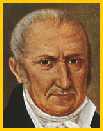
Count Alessandro Giuseppe Antonio Anastasio Volta (Feb. 18, 1745- March 5, 1827) was an Italian physicist (at the University of Pavia) who invented the chemical battery (also called the voltaic pile) in 1800. This invention provided the first generator of continuous electrical current. Volta also discovered (and isolated) methane gas, CH4 (in 1778). He had earlier invented the electrophorus, a device that generated static electricity charges (in 1775). The volt, the unit of electrical potential, was named for Volta in 1881.
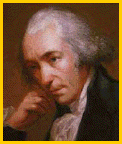
James Watt (1736-1819) was a Scottish inventor and engineer. In 1765, Watt revolutionized the steam engine, redesigning it so that it was much more efficient and four times as powerful as the old Newcomen steam engines. Watt’s engines did not waste steam (heat), and had a separate condenser. Watt partnered with the businessman and factory owner Matthew Boulton in 1772, helping to promote Watt’s ideas commercially. Watt also invented a method for converting the up-and-down piston movement into rotary motion (the “sun-and-planet” gear), allowing a greater number of applications for the engine. Watt produced this rotary-motion steam engine in 1781; it was used for many applications, including draining mines, powering looms in textile factories, powering bellows, paper mills, etc. It helped power the Industrial Revolution. Watt coined the term “horsepower,” which he used to convey the power of his engines; Watt calculated how many horses it would take to do the work of each engine. One horsepower equals 33,000 foot-pounds of work per minute; it is the power required to lift a total of 33,000 pounds one foot in one minute. Parliament granted Watt a patent on his steam engine in 1755, making Watt a very wealthy man. In 1882 (long after Watt’s death), the British Association named the unit of electrical power the “watt.”
Eli Whitney (1765-1825) was an American inventor and engineer. Whitney invented the cotton gin and the idea of interchangeable parts. He patented the cotton gin, which revolutionized the cotton industry on March 14, 1794. The cotton gin is a machine that cleans cotton, removing its many seeds. Previously, this tedious job had been done by hand, using two combs. The cotton gin made much of the southern United States very rich, but cotton plantation owners rarely paid Whitney for the use of his invention, and Whitney went out of business. He never patented his later inventions (like his milling machine). Whitney also helped modernize the musket industry (and mass production in general) by introducing the idea of interchangeable parts in a manufacturing system.