



Glossary of Inventors and Inventions starting with the letter T.
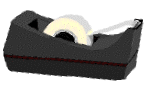
Richard G. Drew (1899-1980) invented masking tape and clear adhesive tape (also called cellophane tape or Scotch tape). Drew was an engineer for the 3M company (the Minnesota Mining and Manufacturing).
Drew’s first tape invention was a masking tape made for painters in 1923 (this tape was designed to help painters paint a straight border between two colors). This early masking tape was a wide paper tape with adhesive on only the edges of the tape - not in the middle. Drew made an improved tape called Scotch (TM) Brand Cellulose Tape in 1930. This tape was a clear, all-purpose adhesive tape that was soon adopted worldwide. The first tape dispenser with a built-in cutting edge was invented in 1932 by John A. Borden, another 3M employee.
Richard G. Drew (1899-1980) invented masking tape and clear adhesive tape (also called cellophane tape or Scotch tape). Drew was an engineer for the 3M company (the Minnesota Mining and Manufacturing).
Drew’s first tape invention was a masking tape made for painters in 1923 (this tape was designed to help painters paint a straight border between two colors). This early masking tape was a wide paper tape with adhesive on only the edges of the tape - not in the middle. Drew made an improved tape called Scotch (TM) Brand Cellulose Tape in 1930. This tape was a clear, all-purpose adhesive tape that was soon adopted worldwide. The first tape dispenser with a built-in cutting edge was invented in 1932 by John A. Borden, another 3M employee.
Tea bags were invented by Thomas Sullivan around 1908. The first bags were made from silk. Sullivan was a tea and coffee merchant in New York who began packaging tea sample in tiny silk bags, but many customers brewed the tea in them (the tea-filled bag was placed directly into the boiling water where the tea brewed, instead of the traditional way of brewing loose tea in a teapot). Later tea bags were made of thin paper.
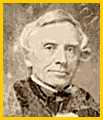
Samuel Finley Breese Morse (1791-1872) was an American inventor and painter. After a successful career painting in oils (first painting historical scenes and then portraits), Morse built the first American telegraph around 1835 (the telegraph was also being developed independently in Europe).
A telegraph sends electrical signals over a long distance, through wires. In 1830, Joseph Henry (1797-1878) made the first long-distance telegraphic device - he sent an electric current for over a mile on wire that activated an electromagnet, causing a bell to ring.
Morse patented a working telegraph machine in 1837, with help from his business partners Leonard Gale and Alfred Vail. Morse used a dots-and-spaces code for the letters of the alphabet and the numbers (Morse Code was later improved to use dots, dashes and spaces: for example E is dot, T is dash, A is dot-dash, N is dash-dot, O is dash-dash-dash, I is dot-dot, S is dot-dot-dot, etc.). By 1838, Morse could send 10 words per minute. Congress provided funds for building a telegraph line between Washington D.C. and Baltimore, Maryland, in 1843. Morse sent the first telegraphic message (from Washington D.C. to Baltimore) on May 24, 1844; the message was: “What hath God wrought?” The telegraph revolutionized long-distance communications.

The telephone (meaning “far sound”) is the most widely used telecommunications device. It was invented in 1876 by Alexander Graham Bell (with Thomas Watson). Bell patented his invention on March 1876 (patent No. 174,465). His device transmitted speech sounds over electric wires, and his idea has remained one of the most useful inventions ever made.

A telescope is a device that lets us view distant objects. Early telescopes (and most today) used glass lenses and/or mirrors to detect visible light. Some modern telescopes gather images from different parts of the electromagnetic spectrum, from radio waves to gamma rays. Most telescopes are located on Earth, but others are in space.
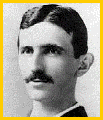
Nikola Tesla (1856-1943) was a Serbian-American inventor who developed the radio, fluorescent lights, the Tesla coil (an air-core transformer that generates a huge voltage from high-frequency alternating current), remote-control devices, and many other inventions; Tesla held 111 patents. Tesla developed and promoted the uses of alternating current (as opposed to direct current, which was promoted fiercely by Thomas Edison and General Electric). Tesla briefly worked with Thomas Edison. The unit of magnetic induction is named for Tesla; a tesla (abbreviated T) is equal to one weber per square meter.

The thermometer was invented by Galileo Galilei in 1593. His thermometer consisted of water in a glass bulb; the water moved up and down the bulb as the temperature changed.
The sealed thermometer was invented in 1641 by the Grand Duke Ferdinand II. He used a glass tube containing alcohol, which freezes well below the freezing point of water (alcohol freezes at -175°F=-115°C). He sealed the tube to exclude the influence of air pressure.
Mercury was later substituted for the alcohol, and then Daniel Gabriel Fahrenheit (1686-1736), a German physicist, used mercury plus a chemical solution that kept the mercury from sticking to the tube of the thermometer (in 1714). Fahrenheit also expanded the thermometer’s scale (in 1724); on his scale, the temperature of boiling water is 212°F and the freezing point of water is 32°F.
 Anders Celsius, a Swedish astronomer, invented the Celsius (or Centigrade) scale in 1742, putting the freezing point of water at 0° and the boiling point at 100°.
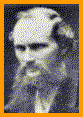 Lord Kelvin (William Thomson, 1824 - 1907) designed the Kelvin scale, in which 0 K is defined as absolute zero and the size of one degree is the same as the size of one degree Celsius. Water freezes at 273.16 K; water boils at 373.16 K.
John S. Thurman invented the gasoline powered vacuum cleaner (which he called the “pneumatic carpet renovator”) in 1899. His vacuum was patented on Oct. 3, 1899 (patent #634,042). It may have been the first motorized vacuum cleaner. Thurman had a run a horse drawn, door-to-door carpet vacuuming service in St. Louis, Missouri, USA, charging $4 per visit (which was a large amount of money at the time).
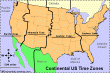
The Earth is divided into 24 time zones so that everyone in the world can be on roughly similar schedules (like noon being roughly when the sun is highest in the sky). The idea to divide the Earth into time zones was proposed by the Canadian railway planner and engineer Sir Sandford Fleming in the late 1870s.
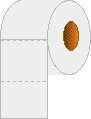
Joseph Gayetty invented toilet paper in 1857. His new toilet paper was composed of flat sheets. Before Gayetty’s invention, people tore pages out of mail order catalogs - before catalogs were common, leaves were used. Unfortunately, Gayetty’s invention failed. Walter Alcock (of Great Britain) later developed toilet paper on a roll ( instead of in flat sheets). Again, the invention failed.
In 1867, Thomas, Edward and Clarence Scott (brothers from Philadelphia, Pennsylvania, USA) were successful at marketing toilet paper that consisted of a small roll of perforated paper . They sold their new toilet paper from a push cart - this was the beginning of the Scott Paper Company.
Evangelista Torricelli (1608 - 1647) was an Italian physicist who invented the mercury barometer (in 1643) and made improvements to the microscope. Torricelli was a pupil of Galileo. Torricelli inverted a glass tube filled with mercury into another container of mercury; the mercury in the tube “weighs” the air in the atmosphere above the container. A barometer is a device that measures air (barometric) pressure. It measures the weight of the column of air that extends from the instrument to the top of the atmosphere. There are two types of barometers commonly used today, mercury and aneroid (meaning “fluidless”).

The tractor is a high power but low-speed vehicle that is used in farming, construction, road building, and other work projects. Some tractors move on wheels, others move on a continuous track. The first gasoline-powered tractor was made in 1892 by John Froehlich, a blacksmith from Iowa. The first mass-produced tractors were sold by C.W. Hart and C.H. Parr of Charles City, Iowa.

Garrett Augustus Morgan (March 4, 1877 - August 27, 1963), was an African-American inventor and businessman. He was the first person to patent a traffic signal. He also developed the gas mask (and many other inventions). Morgan used his gas mask (patent No. 1,090,936, 1914) to rescue miners who were trapped underground in a noxious mine. Soon after, Morgan was asked to produce gas masks for the US Army.
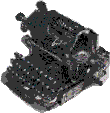
The first typewriter was invented in 1867 by the American printer and editor Christopher Latham Sholes (Feb. 14, 1819 - Feb. 17, 1890). Sholes’ prototype had the user hit a key (for each letter and number), which struck upward onto a flat plate, producing a carbon impression of the letter or number on the paper. He made the prototype using the key of an old telegraph transmitter. There was no way of spacing the letters, no carriage return, and no shift keys; these features would be added to later models.
Carlos Glidden and Samuel W. Soulé also worked in the Kleinstuber Machine Shop with Sholes, and they helped with his inventions. Their first patent was obtained on June 23, 1868. Sholes and Glidden sold the rights to their invention to the investor James Densmore, who eventually had the machine commercially manufactured. Their first commercial model was called the “Sholes & Glidden Type Writer,” and was later called the Remington typewriter. It was produced by the gunmakers E. Remington & Sons in Ilion, NY, from 1874-1878. The first author to submit a typed book manuscript was Mark Twain. Sholes’ typewriter was the beginning of a revolution in communication.