
Advertisement.

EnchantedLearning.com is a user-supported site.
As a bonus, site members have access to a banner-ad-free version of the site, with print-friendly pages.
Click here to learn more.

Join Enchanted Learning
Site subscriptions last 12 months.
Click here for more information on site membership.

$20.00/year or other amount
(directly by Credit Card)

$20.00/year or other amount
(via PayPal)

$20.00/year or other amount
(for sending a check by mail)

$20.00/year or other amount
(for subscribing by school purchase order)
As a thank-you bonus, site members have access to a banner-ad-free version of the site, with print-friendly pages.
(Already a member? Click here.)

hexaflexagon done
EnchantedLearning.com
Make A 3-D Hexaflexagon
Go to a printable version
Regular Polyhedra

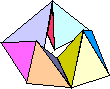
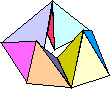
A hexaflexagon (also called a kaleidocycle) is a folded geometric figure that can be "flexed" to expose many sides. This craft is a 3-D hexaflexagon, made of six tetrahedrons. To make a 3-D hexaflexagon, print out the template, cut and fold carefully, then tape (or glue) into shape. You can then "flex" the 3-D hexaflexagon, exposing each of four six-sided faces, one at a time.

The hexaflexagon was invented in 1939 by the Princeton University graduate student Arthur H. Stone (from England). He had trimmed his American notebook paper to fit in his English notebook. He folded the trimmed-off strips and devised the first Hexaflexagon, a flat one that had three faces (this is now called a Trihexaflexagon).

Supplies:

Instructions:
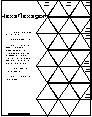
hexaflexagon template Print out the hexaflexagon template. Regular notebook paper is too flimsy to make a good hexaflexagon - stiff paper (like cardstock) makes a workable 3-D hexaflexagon).

To make a larger hexaflexagon, enlarge this pattern in a copy machine.

hexaflexagon 1 Cut along the outside of the figure. Fold along each line. NOTE: Make sure all the cuts (and folds) are exact (or the hexaflexagon will not flex).
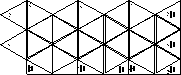
hexaflexagon done Carefully form the paper into a doughnut shape (some of the triangles are folded under an opposing triangle, marked with dots).

Tape (or glue) the middle sections first (making a snake-like figure), then tape or glue the ends together (by putting the proper flaps under triangles).
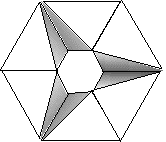
Now you can carefully "flex" the hexaflexagon, exposing the four sides, one at a time. First, make sure all the folds are straight and all the corners are pointy.


Enchanted Learning®
Over 20,000 Web Pages.
Sample Pages for Prospective Subscribers

Overview of Site
What's New
Enchanted Learning Home
Monthly Activity Calendar
Books to Print
Site Index

K-3
Crafts
K-3 Themes
Little Explorers
Picture dictionary
PreK/K Activities
Rebus Rhymes
Stories
Writing
Cloze Activities
Essay Topics
Newspaper
Writing Activities
Parts of Speech

Fiction
The Test of Time
Biology
Animal Printouts
Biology Label Printouts
Biomes
Birds
Butterflies
Dinosaurs
Food Chain
Human Anatomy
Mammals
Plants
Rainforests
Sharks
Whales
Physical Sciences
Astronomy
The Earth
Geology
Hurricane
Landforms
Oceans
Tsunami
Volcano
Languages
Dutch
French
German
Italian
Japanese (Romaji)
Portuguese
Spanish
Swedish
Geography/History
Explorers
Flags
Geography
Inventors
US History

Other Topics
Art and Artists
Calendars
Crafts
Graphic Organizers
Label Me! Printouts
Math
Music

Click to read our Privacy Policy

E-mail


Enchanted Learning Search

First search engine with spelling correction and pictures!
Search EnchantedLearning.com for all the words:
Enter one or more words, or a short phrase.
You can use an asterisk * as a wild-card.


Advertisement.


Advertisement.


Copyright ©2001-2008 EnchantedLearning.com ------ How to cite a web page