
|
| Table of Contents | Enchanted Learning All About Astronomy |
Site Index |
| Our Solar System | Stars | Glossary | Printables, Worksheets, and Activities | ||||||
| The Sun | The Planets | The Moon | Asteroids | Kuiper Belt | Comets | Meteors | Astronomers | ||
 |
Comets | |
| Introduction to Comets | Crossing a Comet's Orbit: Meteor Showers | Comet Origins | Major Comets | Acitvities, Web Links |
|---|
 |
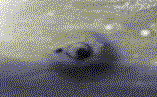 An SL-9 impact site on Jupiter, July 6, 1994. Photo by Hubble Space Telescope. |
HALE-BOPP COMET
Hale Bopp (designated C/1995 O1) is a periodic comet that orbits around the sun. Its earliest-recorded sighting was on July 23, 1995. It was independently discovered by Alan Hale (of New Mexico) and Thomas Bopp (of Arizona), both amateur astronomers. This comet has a diameter of about 40 km; it's rotation rate is 11.4 hours. It was last seen in 1997 and will be seen next in the year 4377; its period is 2380 years.
SOME COMETS
About 600 comets have been observed. About a dozen comets are discovered each year. Most comets have very long periods (over 200 years).
| A Few Comets | Discovered | Last Visit | Next Visit | Period (years) |
|---|---|---|---|---|
| Biela | 1772 | 1852 | broken up | 6.62 |
| Encke | 1786 | 1997 | 2000 | 3.28 |
| Faye | 1843 | 1991 | 1999 | 7.34 |
| Hale-Bopp | July 23, 1995 | 1997 | 4377 | 2380 |
| Halley | 240 B.C. | 1986 | 2061 | 76.00 |
| Hyakutake | January 30, 1996 | 1996 | 31,496 | 29,500 |
| Kohoutek | March 7, 1973 | 1973 | 76,973 | 75,000 |
| Swift-Tuttle aka Kegler (responsible for the Perseids meteor shower) | July 16, 1862 (Kegler first seen in 1737) |
1992 | 2126 | about 130 |
| Wild 2/Comet 81P | January 6, 1978 (by Paul Wild) |
- | - | 6.39 years |
Enchanted Learning®
Over 35,000 Web Pages
Sample Pages for Prospective Subscribers, or click below
|
Overview of Site What's New Enchanted Learning Home Monthly Activity Calendar Books to Print Site Index K-3 Crafts K-3 Themes Little Explorers Picture dictionary PreK/K Activities Rebus Rhymes Stories Writing Cloze Activities Essay Topics Newspaper Writing Activities Parts of Speech Fiction The Test of Time
|
Biology Animal Printouts Biology Label Printouts Biomes Birds Butterflies Dinosaurs Food Chain Human Anatomy Mammals Plants Rainforests Sharks Whales Physical Sciences: K-12 Astronomy The Earth Geology Hurricanes Landforms Oceans Tsunami Volcano |
Languages Dutch French German Italian Japanese (Romaji) Portuguese Spanish Swedish Geography/History Explorers Flags Geography Inventors US History Other Topics Art and Artists Calendars College Finder Crafts Graphic Organizers Label Me! Printouts Math Music Word Wheels |
Click to read our Privacy Policy
| Search the Enchanted Learning website for: |