
|
| You might also like: | Meteors: Zoom Astronomy | Jupiter | Today's featured page: The Sun K-3 Theme Page |
| Our subscribers' grade-level estimate for this page: 3rd - 4th |
| Table of Contents | Enchanted Learning All About Astronomy |
Site Index |
| Our Solar System | Stars | Glossary | Printables, Worksheets, and Activities | ||||||
| The Sun | The Planets | The Moon | Asteroids | Kuiper Belt | Comets | Meteors | Astronomers | ||
 |
Meteoroids, Meteors, and Meteorites | |
| What's the Difference? | Meteoroids Space Debris |
Meteors Falling through the Atmosphere |
Meteor Showers | Meteorites On Earth |
Quiz |
|---|
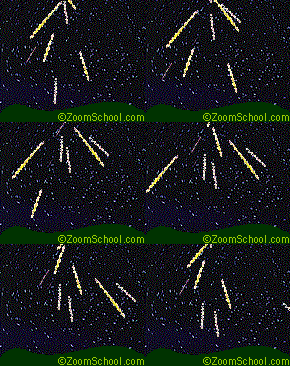 A meteor shower is a phenomenon in which many meteors fall through the atmosphere in a relatively short time and in approximately parallel trajectories. A very intense meteor shower is called a meteor storm.
What Causes a Meteor Shower?
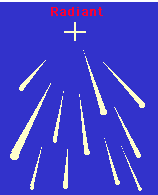 Meteor showers (and meteor storms) occur when the Earth passes through a comet's orbit, and left-over comet debris (rocks, etc.) bombards the Earth. Each meteor shower occurs at a predictable time each year, as the Earth intersects that particular comet's orbit.
How are Meteor Showers Named?
Meteor showers are named for the constellation they seem to originate from (this is called their radiant, the point in the sky from which the shower seems to be coming from). Meteor showers have nothing to do with constellations or stars except for their names. For example, the Orionids meteor shower is named for the constellation Orion because the meteor shower seems to originate in the constellation Orion (although the meteors in this meteor shower are actually debris from Halley's comet and have nothing to do with the constellation Orion).
| Meteor Shower | Approximate Dates | Date of Maximum | Approximate Hourly Rate of Meteors | Velocity km/sec |
Parent Comet |
|---|---|---|---|---|---|
| Quadrantids (visible by Boötes) | Dec. 8-Jan. 7 | Jan. 3 | 40-60 | 42 | unknown |
| Lyrids | Apr. 16-25 | Apr. 22 | 10-15 | 48 | Thatcher 18611 |
| Eta Aquarids | April 21-May 12 | May 5-6 | 20-50 | 66 | Halley (periodic) |
| Delta Aquarids | July 14-Aug.18 | July 28-29 | 20 | 41 | unknown |
| Perseids | July 23-Aug. 22 | Aug. 12 | 50-75 | 60 | Swift-Tuttle (periodic) |
| Orionids | Oct. 15-29 | Oct. 21-22 | 20-25 | 66 | Halley (periodic) |
| Southern Taurids | Sept 17-Nov. 27 | Oct. 30- Nov. 7 | 10-15 | x | Encke (periodic) |
| Leonids | Nov. 14-20 | Nov. 17-18 | 15-80+++ | 71 | Tempel-Tuttle (periodic) |
| Geminids | Dec. 6-19 | Dec. 13-14 | 50-85 | 35 | Asteroid #3200 Phaeton |
| Ursids | Dec. 17-25 | Dec. 22 | 15 | 34 | Tuttle |
Enchanted Learning®
Over 35,000 Web Pages
Sample Pages for Prospective Subscribers, or click below
|
Overview of Site What's New Enchanted Learning Home Monthly Activity Calendar Books to Print Site Index K-3 Crafts K-3 Themes Little Explorers Picture dictionary PreK/K Activities Rebus Rhymes Stories Writing Cloze Activities Essay Topics Newspaper Writing Activities Parts of Speech Fiction The Test of Time
|
Biology Animal Printouts Biology Label Printouts Biomes Birds Butterflies Dinosaurs Food Chain Human Anatomy Mammals Plants Rainforests Sharks Whales Physical Sciences: K-12 Astronomy The Earth Geology Hurricanes Landforms Oceans Tsunami Volcano |
Languages Dutch French German Italian Japanese (Romaji) Portuguese Spanish Swedish Geography/History Explorers Flags Geography Inventors US History Other Topics Art and Artists Calendars College Finder Crafts Graphic Organizers Label Me! Printouts Math Music Word Wheels |
Click to read our Privacy Policy
| Search the Enchanted Learning website for: |