
|
| You might also like: | Butterfly Pupa | Butterfly Wing Anatomy | Label the Butterfly Life Cycle in German | Butterfly Larva | Butterfly Pupa Anatomy | Today's featured page: Butterfly and Caterpillar Crafts |
 Table of Contents |
Enchanted Learning ALL ABOUT BUTTERFLIES! |
Butterfly Calendar |
| What is a Butterfly? | Life Cycle | Butterfly Anatomy | Information Sheets | Glossary | Printables and Activities |
| Butterfly Life Cycle |
| Life Cycle Summary | The Egg | Larva (Caterpillar) | Pupa | Adult |
BUTTERFLY ADULT An adult butterfly emerges full-grown from the chrysalis, often losing reddish meconium fluid as it leaves. When the adult emerges, its wings are wrinkled, wet and deflated, but the abdomen is distended with fluid. The butterfly pumps some of this fluid into the wings through veins to inflate them. The butterfly then rests and then lets the wings dry out. The primary purpose of the adult stage is to mate and reproduce.
 Adults can only eat liquid food through their straw-like proboscis. Most butterflies only sip flower nectar, liquids from rotting fruit, mushy bird dung, and mineral-rich water from puddles (this activity is called puddling). Some butterflies (like the Zebra Longwing) sip pollen. The Harvester Butterfly sips the body fluids from woolly aphids using its proboscis. A few butterflies sip rotting flesh. A rare few lepidoptera (like the great silkmoth) cannot eat at all; they die in about a week, after mating and reproducing.
Coupling: Butterflies mate on the ground or in the air; internal fertilization of the eggs takes from a few seconds to many minutes or hours. During mating, the male transfers a sperm packet (called a spermatophore) into the female; these sperm will fertilize the female's eggs.
Finding A Place to Lay the Eggs: After coupling, the female butterfly searches for the right type of leaves (on a host plant) on which she will will lay her tiny eggs. The female determines if a leaf is appropriate by sensing the taste of the leaf with her feet.
Laying Eggs:  Most butterflies lay their eggs on the underside of a leaf (or under a plant). This way, when the eggs hatch into tiny caterpillars (larvae), their food is all around them and they can start eating immediately. Most eggs are attached to the plant with a fast-drying glue-like chemical that the female butterfly secretes along with the egg. Some species lay one egg at a time, others lay eggs in small clusters, while others lays hundreds at a time. The adults do not provide care for the young.
MIGRATION
Some adult butterflies migrate to avoid cold weather. Some migrate over long distances (up to 2,000 miles, like the Monarch butterfly) and some migrate for very short distances. Long-distance migration can take over three generations of butterflies to complete. Many butterflies do not migrate at all, but stay in the same region their entire lives.
No one knows how butterflies find their way during migrations. Butterflies are tagged in order to learn more about how, when, and where they migrate.
ADULT ANATOMY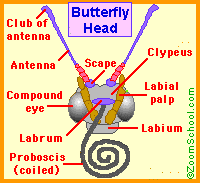 Antennae (singular antenna) are sensory appendages attached to the head of some adult insects. Antennae are used for the sense of smell and balance. Butterflies have two segmented antennae with a small club at the end of each.
A club is the thickened end of a butterfly's antenna.
The proboscis is a a tube-like, flexible "tongue" that butterflies and moths use to sip their liquid food (usually flower nectar or the liquid from rotting fruits). The proboscis uncoils to sip food, and coils up again into a spiral when not in use. The lepidopteran with the longest proboscis is the hawk moth.
Palps are the mustache-like scaly mouthparts of adult butterflies that are on each side of the proboscis. These palps are covered with sensory hairs and scales, and test whether something is food or not.
Legs and Feet: Butterflies have six segmented legs. The two
front legs of about half the butterfly species are very short. The front pair of
legs are frequently used to clean the antennae. Each foot ends in a pair of
grasping claws. The feet are also studded with sense organs and are used to
taste food.
LIFE SPAN
 The life span of butterflies varies widely from species to species. It can also vary within a species, depending on the season when the adult emerges. Overwintering or migrating adults live much longer than early-summer emergents.
Some butterflies and moths live only a few days (like the coppers and small blues). Others live for about 6-12 months (migrating Monarchs, mourning cloaks, and some moths). These long-lived lepidoptera are inactive for most of their life. The life span of most butterflies is in between these two extremes.
Enchanted Learning®
Over 35,000 Web Pages
Sample Pages for Prospective Subscribers, or click below
|
Overview of Site What's New Enchanted Learning Home Monthly Activity Calendar Books to Print Site Index K-3 Crafts K-3 Themes Little Explorers Picture dictionary PreK/K Activities Rebus Rhymes Stories Writing Cloze Activities Essay Topics Newspaper Writing Activities Parts of Speech Fiction The Test of Time
|
Biology Animal Printouts Biology Label Printouts Biomes Birds Butterflies Dinosaurs Food Chain Human Anatomy Mammals Plants Rainforests Sharks Whales Physical Sciences: K-12 Astronomy The Earth Geology Hurricanes Landforms Oceans Tsunami Volcano |
Languages Dutch French German Italian Japanese (Romaji) Portuguese Spanish Swedish Geography/History Explorers Flags Geography Inventors US History Other Topics Art and Artists Calendars College Finder Crafts Graphic Organizers Label Me! Printouts Math Music Word Wheels |
Click to read our Privacy Policy
| Search the Enchanted Learning website for: |