
|
| You might also like: | Dinosaur Defense | Dinosaurs: Male or Female? | Dinosaur Offense | Dinosaur Skin | Dinosaur Anatomy and Behavior | Today's featured page: Flamingo Printout |
 |
DINOSAUR ANATOMY AND BEHAVIOR |
 |
| General Anatomy | Size | Teeth | Herds, Packs | Offense | Defense | Reproduction, Nests & Eggs | Blood Pressure |
| Skeleton | Tails | Brains | Male or Female? | Skin | Diet | Locomotion | Life Span | Hot or Cold Blooded? |
Some herds may have been temporary, however, with the dinosaurs simply congregating temporarily at rich feeding grounds.
 Many sauropods may have travelled in herds, as evidence from multiple trackways (fossilized footprints) suggests. The trackways also indicate that the young sauropods travelled toward the center of the herd for protection.
 A bonebed of about 100 Styracosaurus fossils was found in Arizona, indicating that they also travelled in herds. Protoceratops bonebeds have also been found. Other ceratopsians, like Triceratops, may have also travelled in herds.
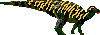 Maiasaura fossils have been found in a huge group of about 10,000 animals. This strongly indicates herding behavior. These Maiasauras were buried in volcanic ash along with a field of nests and eggs. Other duck-billed dinosaurs (hadrosaurs like Parasaurolophus) may have also congregated in herds to feed, nest, and perhaps migrate.
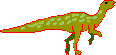 A bonebed of about 20 Hypsilophodon fossils were unearthed together on the Isle of Wight (an island off the coast of southern England).
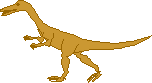 Several hundred Coelophysis fossil skeletons have been found in Arizona, New Mexico, and perhaps Utah. Adults and juveniles of this meat-eating dinosaur have been found.
 and Dryosaurus.
Some meat-eating dinosaurs may have hunted in packs, combining their strength in order to kill very large prey.
 The deadly and intelligent Velociraptor may have hunted in packs, attacking even very large animals. Other Dromeosaurids (the most intelligent dinosaurs), like Deinonychus may have also hunted in deadly packs, attacking even huge sauropods and ankylosaurids.
|
DINOSAUR ANATOMY AND BEHAVIOR |
|
| General Anatomy | Size | Teeth | Herds, Packs | Offense | Defense | Reproduction, Nests & Eggs | Blood Pressure |
| Skeleton | Tails | Brains | Male or Female? | Skin | Diet | Locomotion | Life Span | Hot or Cold Blooded? |
Enchanted Learning®
Over 35,000 Web Pages
Sample Pages for Prospective Subscribers, or click below
|
Overview of Site What's New Enchanted Learning Home Monthly Activity Calendar Books to Print Site Index K-3 Crafts K-3 Themes Little Explorers Picture dictionary PreK/K Activities Rebus Rhymes Stories Writing Cloze Activities Essay Topics Newspaper Writing Activities Parts of Speech Fiction The Test of Time
|
Biology Animal Printouts Biology Label Printouts Biomes Birds Butterflies Dinosaurs Food Chain Human Anatomy Mammals Plants Rainforests Sharks Whales Physical Sciences: K-12 Astronomy The Earth Geology Hurricanes Landforms Oceans Tsunami Volcano |
Languages Dutch French German Italian Japanese (Romaji) Portuguese Spanish Swedish Geography/History Explorers Flags Geography Inventors US History Other Topics Art and Artists Calendars College Finder Crafts Graphic Organizers Label Me! Printouts Math Music Word Wheels |
Click to read our Privacy Policy
| Search the Enchanted Learning website for: |