
|
 Table of Contents |
Enchanted Learning All About Sharks! |
 Geologic Time Chart |
| Introduction to Sharks | Introduction to Rays | Anatomy | Shark and Ray Species | Extreme Sharks | Extinct Sharks | Classification | Shark Glossary | Shark Index | Printables, Worksheets, and Activities |
 |
|
||||||||||
| A | B | C | D | E | F | G | H | I | J | K | L | M | N | O | P | Q | R | S | T | U-Z |
 ICE AGE An ice age is a time lasting thousands of years during which the Earth is very cold and largely covered by ice and glaciers. |
  ICHNOFOSSILS Also known as trace fossils, these are fossilized footprints, nests, dung, gastroliths, etc., but not actual body parts. Ichnofossils record the movement and behavior of animals. |
ICHTHYOLOGIST Ichthyologists are scientists who study fish. |
 ICHTHYOSAUR Ichthyosaurs were prehistoric reptiles that lived in the sea. |
 IGNEOUS ROCK When molten rock cools, igneous rock is formed. |
  INDEX FOSSILS Index fossils are commonly found fossils that are limited in time span. They help in dating other fossils. For example: trilobites were common during the Paleozoic, but not found before the Permian period, and ammonites were common during the Mesozoic Era, but not found after the Cretaceous period. |
  INSECTS Insects have exoskeletons and six legs. They evolved during the Silurian Period, 438 to 408 mya, long before dinosaurs or whales existed. |
INTERSPECIFIC COMPETITION Interspecific competition is competition between two different species of organisms (competing for food, territory, etc.). |
INTRASPECIFIC COMPETITION Intraspecific competition is competition among members of a species (competing for food, mates, territory, etc.). |
  INVERTEBRATE Invertebrates are animals without a backbone. Some invertebrates include protozoans, arthropods (insects, arachnids, crustaceans, etc.), worms, jellyfish, sponges, mollusks (like cephalopods [octopus], gastropods, bivalves [clams, oysters, scallops]), and many others. |
IRIDESCENT SHARK The iridescent shark, Pangasius sutchi, is not a real shark - it is a type of catfish that superficially resembles a shark. It is an aggressive fresh-water fish that preys upon smaller fish. The iridescent shark is a popular home aquarium fish. |
IRIDIUM ANOMALY Iridium is an element that is rare on the Earth's surface, but abundant on chondritic meteors. The presence of excess Iridium at the K-T layer (the Iridium anomaly) supports the Alvarez asteroid theory. |
 ISOTOPE An isotope of an element is another form of the same element, that has a different number of neutrons in the nucleus (giving it a different atomic weight). |
IZAK CATSHARK The Izak catshark, Holohalaelurus regani, is also known as the Izak shark and the shy eye shark. This shark hides its eyes with is tail when it is caught. It has dark brown skin above, with lighter dots and lines. The belly is much lighter. The Izak shark grows to be up to 2 feet (61 cm) long. It has an anal fin, 5 gill slits, 2 dorsal fins, no fin spines, mouth behind the eyes, slit-like pupils, and nictitating eyelids. It is oviparous, laying eggs (3.5 by 1.5 cm) that were internally fertilized. The Izak catshark was named by Gilchrist in 1922. Classification: Order Carcharhiniformes (ground sharks), Family Scyliorhinidae (catsharks), Genus Holohalaelurus, Species H. regani. |
Birds evolved and many dinosaurs flourished during the Jurassic period, 208-146 million years ago. |
JUVENILE A juvenile animal is one that is weaned from its mother (no longer drinking mother's milk) but is not yet sexually mature. |
 KERATIN Keratin is the stiff substance that baleen, hooves, hair, horns, and fingernails are made of. |
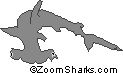 KIDNEY-HEADED SHARK Kidney-headed sharks Sphyrna lewini are also known as Scalloped Hammerheads. The front of the head of this shark is flattened, scalloped and wide, forming a structure called a cephalofoil. This oddly-shaped head helps the shark swim, making the shark more hydrodynamic. The eyes are at the tip and slightly below the head. The head is also dense with sensory receptors. Kidney-headed sharks grow to be about 10-13 ft (3-4 m) long. They swim in warm temperate and tropical waters. They eat bony fish, and cephalopods. Pups are born live in litters of 15-30; they are 17-22 inches (43-55 cm) long at birth. Classification: Order Carcharhiniformes |
 KILLER WHALE Killer whales, or orcas, (Orcinus orca) are toothed whales, powerful carnivores that eat fish, squid, and marine mammals. They grow to be about 27 feet long (8 m) and weigh about 8,000 - 12,000 pounds (3600-5400 kg). |
KINGDOM In classification, a kingdom is the highest grouping of similar organisms. A kingdom contains one or more phyla (plural of phylum). Life on Earth is divided into five kingdoms: Animalia (animals), Plantae (plants), Fungi, Protista (protozoans and eucaryotic algae), and Monera (blue-green algae). |
KNOPP'S SHARK The bignose shark (Carcharhinus altimus) is also known as Knopp's shark. This bottom dweller is found in warm-temperate and tropical seas. It is up to about 10 ft (3 m) long. The skin is ash-colored, but is lighter on the belly; the fins have dark tips. Bony fish is the mainstay of the diet (mackerel is a favorite). The bignose is viviparous; litters contain from 3 to 11 pups. Newborns are 27 to 35 inches (70-90 cm) long. It was named by Springer in 1950. |
knot A knot is a unit of speed used on the water, and is defined as one nautical mile per hour. A knot is equal to about 1.15 miles per hour (6,080 feet per hour). For example, 20 knots is about 23 mph. |
 KRILL Krill are tiny animals, euphasiids, that float in the oceans. They are shrimp-like crustaceans that are found in vast amounts in the cold waters of the Arctic and Antarctic Oceans. Baleen whales eat krill that they sieve through their baleen. Blue whales can eat about 4 tons of krill each day. |
K-T EXTINCTION The K-T extinction was the mass extinction that occurred 65 million years ago, at the boundary of the Cretaceous and Tertiary periods. |
|
Shark Glossary |
|
|||||||||
| A | B | C | D | E | F | G | H | I | J | K | L | M | N | O | P | Q | R | S | T | U-Z |
Enchanted Learning®
Over 35,000 Web Pages
Sample Pages for Prospective Subscribers, or click below
|
Overview of Site What's New Enchanted Learning Home Monthly Activity Calendar Books to Print Site Index K-3 Crafts K-3 Themes Little Explorers Picture dictionary PreK/K Activities Rebus Rhymes Stories Writing Cloze Activities Essay Topics Newspaper Writing Activities Parts of Speech Fiction The Test of Time
|
Biology Animal Printouts Biology Label Printouts Biomes Birds Butterflies Dinosaurs Food Chain Human Anatomy Mammals Plants Rainforests Sharks Whales Physical Sciences: K-12 Astronomy The Earth Geology Hurricanes Landforms Oceans Tsunami Volcano |
Languages Dutch French German Italian Japanese (Romaji) Portuguese Spanish Swedish Geography/History Explorers Flags Geography Inventors US History Other Topics Art and Artists Calendars College Finder Crafts Graphic Organizers Label Me! Printouts Math Music Word Wheels |
Click to read our Privacy Policy
| Search the Enchanted Learning website for: |


