



Page 248 of 259
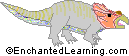
Bagaceratops Printout. Bagaceratops was a plant-eating dinosaur that had a toothless beak and cheek teeth.
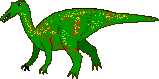
Baryonyx was a large, meat-eating spinosaurid dinosaur - a theropod from the early Cretaceous period.
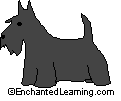
Scottish Terrier Printout. The Scottish Terrier (also called the Scotty and the Aberdeen Terrier) is a bold, alert, robust, fearless dog.

Coloring and drawing worksheets for Christmas.
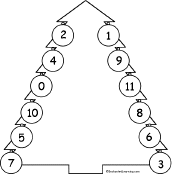
Printouts for Christmas on math, sorting, patterns, and counting.

Halloween Crafts for kids. Kindergarten, preschool, and elementary school crafts. Make wonderful, simple Halloween crafts with things found around the house.

The voters in Mississippi have ratified a new state flag. It features the magnolia, which is the state flower. You can print out Mississippi’s flag, color it, and take a short quiz.
Learn how the largest stars in the universe will eventually supernova and then collapse, turning into black holes.

Learn about how new stars are born/formed with this informative page.
Recently, other stars with orbiting planets have been discovered. These planets have not been seen, but have been detected by the very slight ‘wobble’ they induce in their star.

A constellation is a group of stars that, when seen from Earth, form a pattern. There are 88 constellations.

An active galaxy is a galaxy that produces huge amounts of energy; they produce more energy than the total energy emitted from each of the stars in the nebula.
A cluster of galaxies is a system of galaxies that contains up to thousands of galaxies bound together by gravitational forces.

An elliptical galaxy is a galaxy with a smooth, elliptical shape. It has no spiral arms and is generally yellow-red in color.
An irregular galaxy is a galaxy with no rotational symmetry. Learn more about them here.

Lenticular Galaxies are lens-shaped galaxies containing older stars.
A list of the brightest stars in the observable universe, both as observed from Earth and their absolute magnitude.
Learn about how a star dies in this Astronomy information page.
Learn about how stars like our Sun eventually die.

A list of the stars nearest to earth. The closest star to us is the Sun.